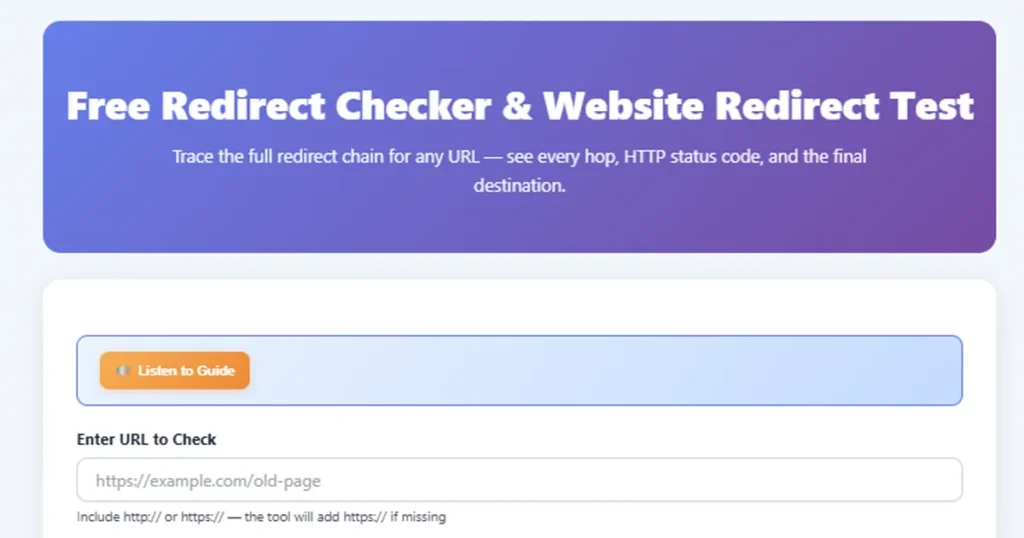
Redirect Checker
Trace the full redirect chain for any URL — see every hop, HTTP status code, and the final destination
Include http:// or https:// — the tool will add https:// if missing
How to Use the Redirect Checker
- Type or paste the URL you want to check into the input field. Include http:// or https:// for best results.
- Click the Check Redirects button or press Enter to start tracing the redirect chain for the entered URL.
- The tool displays each hop in the redirect chain with the HTTP status code, URL, and redirect type.
- The last entry in the chain shows the final destination URL where the browser ultimately lands.
- Review status codes to identify unnecessary redirects, redirect loops, or incorrect redirect types that may hurt SEO.
Key Features
Full Chain Tracing
Follow every hop from the original URL to the final destination, revealing the complete redirect path.
HTTP Status Codes
See exact status codes (301, 302, 307, 308, 200) for each step so you know the redirect type.
Loop Detection
Automatically detects circular redirect loops that would cause infinite browser redirects.
Fast Results
Get complete redirect chain analysis in seconds, no matter how many hops are involved.
SEO Insights
Identify redirect issues that hurt search rankings — wrong types, unnecessary chains, and broken paths.
Works on Any Device
Fully responsive design works on phones, tablets, and desktops with no app installation needed.
Understanding HTTP Redirect Status Codes
Every redirect response from a server includes an HTTP status code that tells browsers and search engines why the redirect is happening. Here's what each code means:
| Code | Name | Type | SEO Impact |
|---|---|---|---|
| 301 | Moved Permanently | Permanent | Passes ~90-99% link equity to new URL |
| 302 | Found | Temporary | Original URL stays indexed, limited equity transfer |
| 307 | Temporary Redirect | Temporary | Like 302 but preserves HTTP method (POST stays POST) |
| 308 | Permanent Redirect | Permanent | Like 301 but preserves HTTP method |
| 200 | OK | No redirect | Final destination — page loaded successfully |
The critical distinction: 301 and 308 are permanent — search engines transfer ranking signals and eventually deindex the old URL. 302 and 307 are temporary — search engines keep the old URL indexed, assuming the redirect will be removed eventually.
Using a 302 when you mean 301 is one of the most common and damaging SEO mistakes. It splits your ranking authority between two URLs instead of consolidating it on one.
Practical Examples
🇮🇳 Ankit — Mumbai, India
Ankit migrated his e-commerce store from HTTP to HTTPS. After migration, his organic traffic dropped 40%. He ran the Redirect Checker and discovered his old HTTP URLs were 302-redirecting to HTTPS instead of 301-redirecting.
Result: After fixing to 301 redirects, Google consolidated the rankings within 3 weeks and traffic recovered.
🇮🇳 Priya — Bengaluru, India
Priya's blog was on a subdomain (blog.example.com) and she moved it to a subfolder (example.com/blog/). She used the Redirect Checker to verify that all 200+ old blog post URLs correctly 301-redirected to their new locations.
Result: Zero broken links and seamless SEO transition with no ranking drops.
🇺🇸 David — Chicago, USA
David noticed his site was slow to load. The Redirect Checker revealed a 4-hop chain: http://example.com → https://example.com → https://www.example.com → https://www.example.com/ — three unnecessary redirects before the page even loaded.
Result: Consolidated to a single redirect, cutting 600ms from page load time.
🇩🇪 Lisa — Berlin, Germany
Lisa was building backlinks but her affiliate partner's short URLs were redirecting through 5 different tracking domains before reaching her site. The Redirect Checker mapped the entire chain so she could request a cleaner redirect path.
Result: Reduced the chain to 2 hops, improving both user experience and link equity transfer.
What Is a URL Redirect?
A URL redirect is a server instruction that sends browsers and search engines from one URL to a different URL. When you type a URL or click a link, the server responds with a redirect status code and a new location. Your browser then automatically navigates to that new location — often so fast you don't even notice it happened.
Redirects are essential for website maintenance. When you change your domain name, restructure your site, merge duplicate pages, or switch from HTTP to HTTPS, redirects ensure that visitors and search engines find the right page instead of hitting a 404 error. They're the forwarding addresses of the internet.
However, redirects can also cause problems. Chains of multiple redirects slow down page loads. Wrong redirect types confuse search engines. And redirect loops crash browsers entirely. That's why checking your redirects regularly is a critical part of SEO and website maintenance.
URL Redirects in Multiple Languages
Frequently Asked Questions
Is this tool free to use?
What is a 301 redirect?
What is a 302 redirect?
What is the difference between 307 and 308 redirects?
Why are redirect chains bad for SEO?
How many redirects are too many?
What does a 200 status code mean in the results?
Can this tool detect redirect loops?
Does this tool check meta refresh redirects?
Why should I use 301 instead of 302 for permanent moves?
Recommended Hosting
Hostinger
If you are building a website for your tools, blog, or store, reliable hosting matters for speed and uptime. Hostinger is a popular option used worldwide.
Visit Hostinger →Disclosure: This is a sponsored link.
Contact Us
Related Tools You May Like
Share This Tool
Found this tool useful? Share it with friends and colleagues.